

Science fiction film has come a long way from silent cinema to digital effects. Below are six films that Wikipedia describes as classics of the genre: they influenced later films, games and series, and it’s useful to know them even if you haven’t seen any of them yet.
Facts come from Wikipedia pages checked on October 14, 2026. We don’t give our own ratings: for each film we explain what the story is and what it is known for. Each film has a card on our site with its main details.
Metropolis
A silent film about a city of the future, where the rich live above and the workers toil below; the son of the city’s ruler and a girl named Maria try to bridge that gap. The film’s main message is expressed in its final title card: “The mediator between the head and the hands must be the heart.” Filming lasted 17 months and cost more than five million Reichsmarks. After the German premiere the film was heavily cut; in 2008 a damaged copy of the original version was found in a museum in Argentina, and the restored version was shown simultaneously in Berlin and Frankfurt on February 12, 2010. In 2001 the film became the first motion picture added to UNESCO’s Memory of the World Register, and on January 1, 2023 it entered the public domain in the United States.
Who it’s for: for those who want to see where science fiction film began.
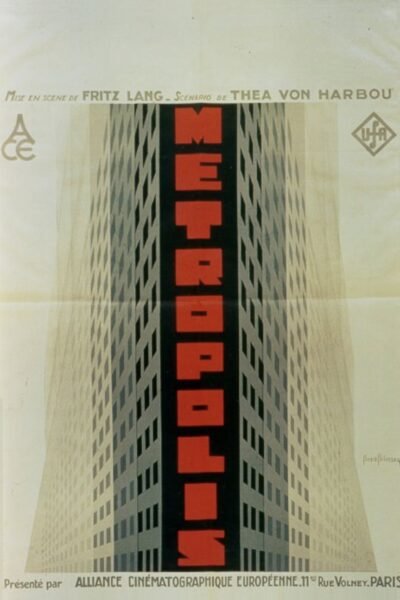 Metropolis1927 · dramaWhere to watch and the card →
2001: A Space Odyssey
Astronauts, scientists and the thinking supercomputer HAL 9000 travel to Jupiter to investigate a mysterious alien monolith. Kubrick wrote the script together with Arthur C. Clarke; there is little dialogue, and the long scenes are accompanied only by music, including works by Richard Strauss and György Ligeti. The film won an Oscar for visual effects, Kubrick’s only Oscar. In 2022 it entered the top ten of the Sight and Sound critics’ poll.
Who it’s for: for those who love slow cinema that leaves room for their own interpretations.
2001: A Space Odyssey1968 · adventureWhere to watch and the card →Alien
The crew of a commercial spaceship explores an abandoned spacecraft and becomes prey to a deadly alien creature. The script was written by Dan O’Bannon from a story by O’Bannon and Ronald Shusett, and the creature and its surroundings were designed by Swiss artist H. R. Giger. Reviews were mixed at first, but the film won an Oscar for visual effects, and it was later named one of the most influential films of the science fiction and horror genres. It launched a franchise: Aliens (1986), Alien 3 (1992) and other films followed.
Who it’s for: for those who love space horror and a tense atmosphere.
Alien1979 · horrorWhere to watch and the card →Blade Runner
Los Angeles, 2019: former police officer Rick Deckard must track down a group of runaway replicants, synthetic humans created to work in space colonies. The film is based on Philip K. Dick’s novel Do Androids Dream of Electric Sheep? (1968); Harrison Ford, Rutger Hauer and Sean Young star. In its North American release it was a disappointment and divided critics, but it later became a cult classic; the music was written by Vangelis. There are seven different versions of the film, and the sequel, Blade Runner 2049, came out in 2017.
Who it’s for: for those who love a bleak future and a detective storyline.
Blade Runner1982 · dramaWhere to watch and the card →The Terminator
A cyborg assassin from the future travels to 1984 to kill Sarah Connor, whose son will one day lead the resistance against the artificial intelligence Skynet; a soldier arrives after him to protect her. The special effects were produced by a team led by Stan Winston and Gene Warren Jr. The film cost $6.4 million and grossed $78.3 million; according to Wikipedia, it launched Cameron’s career and cemented Arnold Schwarzenegger’s status as a leading actor. This film is also part of our selection of time travel films.
The Terminator1984 · actionWhere to watch and the card →The Matrix
The hacker Neo learns that his world is an elaborate deception created by machines, and joins the rebels led by Morpheus. The Wachowskis combined the influence of anime, Hong Kong martial arts cinema and cyberpunk; the “bullet time” effect became one of the film’s trademarks. According to Wikipedia, The Matrix grossed more than $460 million on a $63 million budget and won four Oscars: for visual effects, film editing, sound, and sound effects editing.
Who it’s for: for those who love cyberpunk and spectacular fight scenes.
The Matrix1999 · actionWhere to watch and the card →How much time it takes
Running time isn’t the most important thing, but it helps you plan an evening. Data from Wikipedia infoboxes; for Metropolis this is the original German version, and for Blade Runner it is the first theatrical cut of 1982.
| Film | Year | Running time |
|---|---|---|
| Metropolis | 1927 | 153 min |
| 2001: A Space Odyssey | 1968 | 139 min |
| Alien | 1979 | 116 min |
| Blade Runner | 1982 | 117 min |
| The Terminator | 1984 | 107 min |
| The Matrix | 1999 | 136 min |
Where to start with the classics
All six films differ in pace, so choose by mood.
| What you feel like | What to pick |
|---|---|
| Silent cinema and visual experiments | Metropolis |
| Slow science fiction to think about | 2001: A Space Odyssey |
| Space horror | Alien |
| A bleak future with a detective | Blade Runner |
| A dynamic action film | The Terminator |
| Cyberpunk and fight scenes | The Matrix |
If you want modern space science fiction, watch Christopher Nolan’s Interstellar: all of his films are collected in our article on Nolan’s films in release order.
Tip. Older films are best watched without rushing and without a phone: Metropolis and 2001: A Space Odyssey have many long scenes designed for attention and a big picture.
Frequently asked questions
Which film should I start with if the classics seem hard?
Start with The Terminator or The Matrix: these are dynamic action films with a clear idea. The slowest-paced film in the selection is 2001: A Space Odyssey.
Is Metropolis really in the public domain?
According to Wikipedia, on January 1, 2023, the American copyright on the film expired, and it entered the public domain in the United States. Other countries may have different rules, so check them before distributing copies.
Are there several versions of Blade Runner?
Yes. According to Wikipedia, there are seven versions of the film. The Final Cut was released in 2007 by Warner Bros.: it is the only version over which Ridley Scott retained creative control.
Do these films have sequels?
Yes, most of them. According to Wikipedia, Alien was followed by Aliens (1986), Alien 3 (1992) and other films; The Matrix has two sequels from 2003, and in 2021 a fourth film, The Matrix Resurrections, came out; the sequel to Blade Runner, Blade Runner 2049, came out in 2017. 2001: A Space Odyssey got a sequel, 2010 (1984), made without Kubrick’s involvement.
Where can I watch these films?
Streaming catalogs change, so we don’t list them. Check the film’s page on a service available to you; each film’s card on our site also has a “Where to watch” block.
Sources
- Metropolis (1927 film) (Wikipedia)
- 2001: A Space Odyssey (film) (Wikipedia)
- Alien (film) (Wikipedia)
- Blade Runner (Wikipedia)
- The Matrix (Wikipedia)
Data was checked against live Wikipedia pages on October 14, 2026.



Discussion